
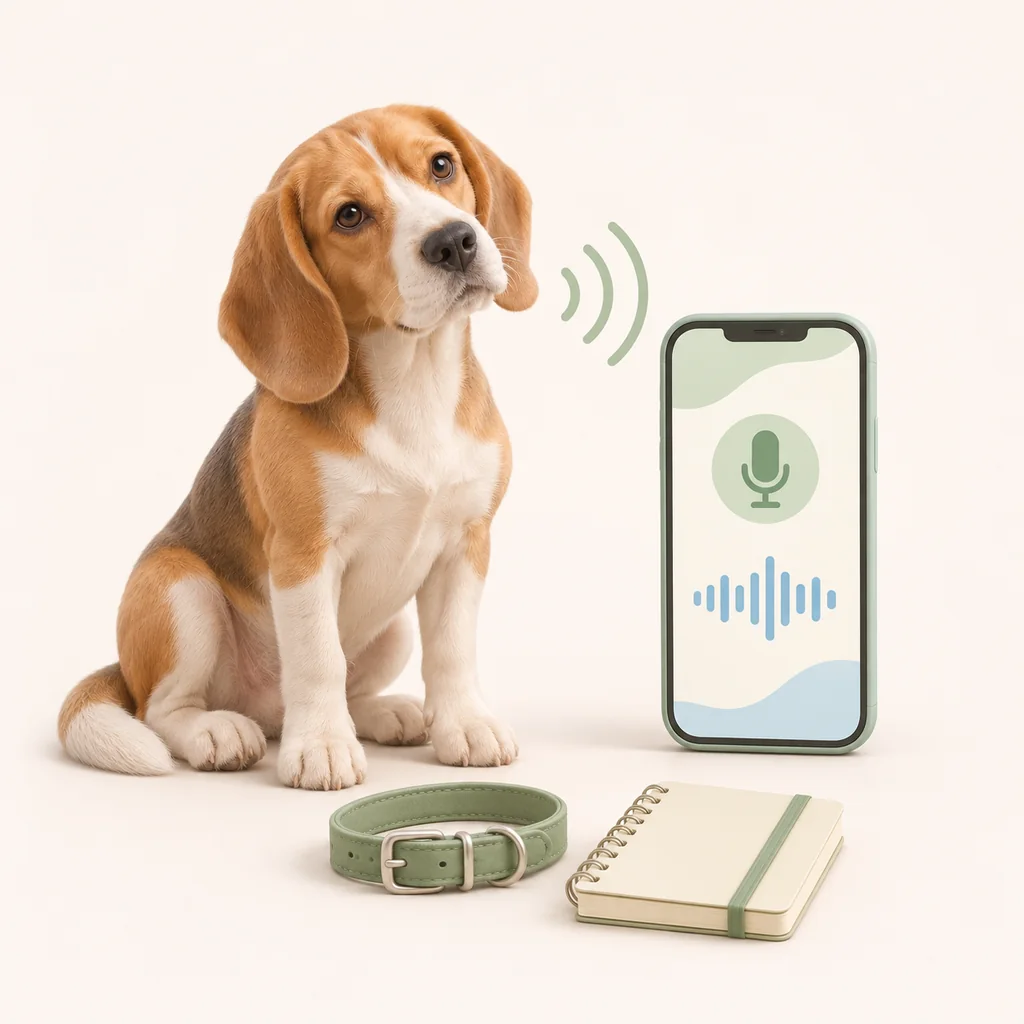
A dog translator app can help you observe dog sounds more consciously. Tasma’s pet sound analysis offers possible interpretations of a recording, not a literal translation into human language. The assessment becomes more meaningful when you also observe body posture, surroundings, and the specific situation.
Maybe your dog barks when the doorbell rings, whines before a walk, or makes unusual sounds while playing. You want to understand what might be behind it. This guide explains how to use Voice Translation in Tasma sensibly, which expectations are helpful, and why a single recording does not provide a certain answer to every behavioral question.
What does “Dog Translator App” actually mean?
The search term sounds like a dictionary between dog and human. In everyday life, however, it is usually about something else: owners want to understand barking, compare vocalizations, and accompany their dog more attentively. An understandable sentence on a screen is not yet proof that an animal has expressed that exact thought.
A clear distinction is therefore helpful: a recording captures a sound. An AI can offer a possible interpretation of it. What the situation means for your dog cannot be read from this with certainty. View a result as a prompt for further observation, not as a definitive statement from your dog.
Voice Translation in Tasma: Viewing pet sounds in context
Tasma’s pet sound analysis is aimed at dog and cat owners. You record your pet and explore possible meanings of their sounds. That is precisely where the benefit of the feature searched for as Voice Translation lies: it opens up an additional perspective on a specific recording, while the interpretation should remain verifiable and provisional.
A practical starting point is a question like: What happened immediately before this sound? Mentally add whether your dog had just been playing, is waiting for someone, or is reacting to a noise. The audio track does not automatically show everything happening outside the recording. Always compare the classification with your own observations.
MORE ABOUT THE FEATURES: Discover pet sound analysis and other Tasma tools →
Understanding barking: Why context is crucial
Barking is part of canine communication and can occur in various situations. The RSPCA explains possible contexts for barking, including excitement, frustration, boredom, or fear. This does not result in a fixed assignment where every short or loud bark always has the same meaning.
Imagine two similar recordings: one is made during shared play, the other after an unexpected noise in the hallway. Even if both sound lively, the situation differs. A dog translator app is therefore most useful when it directs your attention to such differences instead of replacing context with a seemingly unambiguous label.
Recognizing dog language: Body language is part of it
In addition to the sound, pay attention to the entire body posture: How is your dog moving, where is it directing its attention, and is it seeking closeness or distance? Individual signals should not be read in isolation. The body language guide from Dogs Trust describes how important the connection between different signals is for understanding. Dogs Trust
You do not need to create a complicated rating scale for this. First describe neutrally what you actually saw. “He went to the door and barked after the doorbell rang” is a more useful observation than “He was definitely angry.” This keeps the difference between observation and interpretation recognizable even when discussing an app result.
Using a dog translator app sensibly in everyday life
Choose a naturally occurring situation for a recording. Leave your dog as undisturbed as possible and do not provoke barking just to get an interesting result. TV audio, multiple animals, or background conversations can make it harder to classify a sound. A recording with little background noise is also easier for you to follow.
Then read the suggested interpretation and ask yourself what supports it and what information is missing. If it does not fit the situation, do not treat it as fact. Even plausible-sounding text can be wrong. Value comes from careful observation and asking follow-up questions, not from running as many analyses as possible.
READ MORE ON THE TASMA BLOG: Organize dog health, vaccinations, and everyday information →
Download Tasma:
Respecting the limits of dog sound analysis
Tasma’s pet sound analysis is an informational tool. It confirms neither a diagnosis nor a specific emotion or the safety of a situation. If your dog’s behavior changes suddenly or something worries you, an app result should not delay professional clarification.
For everyday life, a simple sequence remains helpful: listen, observe the situation, read the interpretation critically, and note down open questions. Tasma combines pet sound analysis with other pet care tools. Check the features and access conditions currently available in your app rather than inferring a specific scope of services from the term dog translator app.
Dog Translator App: Five frequently asked questions
Can a dog translator app translate barking literally?
Tasma offers possible interpretations of pet sounds, not a literal translation. A result should be viewed together with the observed situation and not taken as a verified sentence from your dog.
How does Voice Translation work in Tasma?
You record your dog or cat and explore possible meanings of the sounds. Pet sound analysis supplements your observations; it provides no certainty about thoughts or feelings.
Why does a dog sound analysis sometimes not fit the situation?
The recording may lack important information. Background noise and the non-visible situation make classification more difficult. AI interpretations can also be wrong; therefore check them against what you have observed.
Should I make my dog bark for the recording?
It is better to use a naturally occurring vocalization. An analysis should not be a reason to startle, pressure your pet, or intentionally create a stressful situation.
Does a dog translator app replace professional help?
No. In the event of noticeable changes or concerns about your dog, professional support is important. The app can spark questions, but it does not replace a veterinary examination or individual behavioral advice.